
Delving into Hedge Fund Investment Strategies, this introduction immerses readers in a unique and compelling narrative, with a focus on maximizing returns through strategic investments. From defining hedge funds to exploring different investment strategies, this overview sets the stage for a deeper understanding of the topic.
As we navigate through the complexities of long/short equity, global macro, and event-driven strategies, it becomes evident that successful hedge fund investments require a careful balance of risk management and market insights.
Hedge Fund Investment Strategies
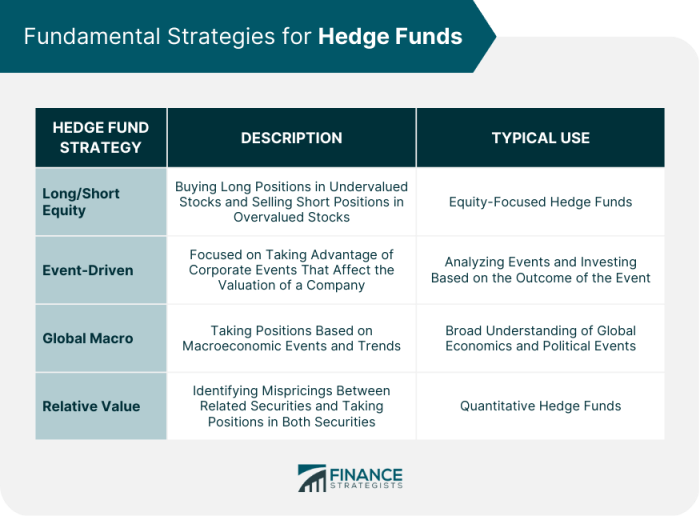
Hedge funds play a crucial role in the investment landscape as they aim to generate high returns for investors by employing a wide range of strategies that traditional investment funds may not utilize. These funds are typically open only to accredited investors and have more flexibility in their investment approaches compared to mutual funds.
Types of Hedge Fund Investment Strategies
- Long/Short Equity: This strategy involves buying undervalued securities (long positions) while simultaneously selling overvalued securities (short positions) to hedge against market risk.
- Global Macro: Global macro funds invest in various asset classes based on macroeconomic trends and geopolitical events, aiming to capitalize on global market shifts.
- Event-Driven: Event-driven strategies focus on profiting from corporate events such as mergers, acquisitions, bankruptcies, or restructurings by taking advantage of price discrepancies.
- Quantitative: Quantitative hedge funds use mathematical models and algorithms to identify investment opportunities based on statistical analysis and historical data.
Key Characteristics of Successful Hedge Fund Investment Strategies
- Flexibility: Successful hedge fund strategies are adaptable and can pivot quickly to capitalize on changing market conditions and opportunities.
- Risk Management: Effective risk management is crucial in hedge fund investments to protect capital and minimize losses during volatile market periods.
- Alpha Generation: Hedge funds aim to generate alpha, which represents the excess return on an investment compared to the market’s performance, through skillful investment strategies.
Importance of Risk Management in Hedge Fund Investments
Risk management is a critical component of hedge fund investing as these funds often engage in complex strategies that carry inherent risks. By employing robust risk management practices, hedge fund managers can protect investor capital, preserve wealth, and navigate turbulent market conditions effectively.
Long/Short Equity Strategy
The long/short equity strategy is a popular investment approach used by hedge funds to take both long positions (buying stocks expected to increase in value) and short positions (selling stocks expected to decrease in value) in the equity market. The primary objective of this strategy is to generate positive returns regardless of the overall market direction, by profiting from both rising and falling stock prices.
Implementation of Long/Short Equity Strategies in Hedge Funds
Long/short equity strategies are typically implemented by hedge fund managers through thorough fundamental analysis and research to identify undervalued stocks to buy (long positions) and overvalued stocks to sell short (short positions). This strategy aims to capitalize on the manager’s ability to pick winning stocks while hedging against market risks.
- Managers may use quantitative models, technical analysis, and other tools to identify potential investment opportunities.
- Portfolio diversification is crucial to manage risk effectively and enhance returns.
- Active risk management is employed to adjust positions based on market conditions and new information.
Benefits and Risks Associated with Long/Short Equity Strategies
Implementing long/short equity strategies offers several benefits, such as:
- Ability to generate positive returns in various market conditions.
- Opportunity to outperform traditional long-only equity strategies.
- Potential for downside protection during market downturns.
However, there are also risks involved in long/short equity strategies, including:
- Market risk: Fluctuations in stock prices can impact the overall portfolio.
- Short-selling risk: Short positions can result in unlimited losses if the stock price rises significantly.
- Leverage risk: Some hedge funds may use leverage to amplify returns, increasing the potential for losses.
Examples of Successful Long/Short Equity Hedge Fund Managers
Some examples of successful long/short equity hedge fund managers include:
- William Ackman of Pershing Square Capital Management
- David Einhorn of Greenlight Capital
- Ken Griffin of Citadel
Global Macro Strategy
Global macro strategy is an investment approach that focuses on making investment decisions based on macroeconomic trends and events happening around the world. Instead of analyzing individual companies, global macro hedge funds look at the bigger picture, considering factors like interest rates, GDP growth, geopolitical events, and other macroeconomic indicators to make investment decisions.
How Hedge Funds Use Global Macro Strategy
Global macro hedge funds use the global macro strategy to capitalize on shifts in global economies and markets. By analyzing and predicting macroeconomic trends, these funds can take positions in various asset classes, such as currencies, commodities, equities, and bonds. They may go long on assets they believe will increase in value and short assets they expect to decline, aiming to generate profits regardless of the market direction.
Challenges and Opportunities of Global Macro Strategies
Implementing global macro strategies comes with both challenges and opportunities. One challenge is accurately predicting macroeconomic trends, as these can be influenced by various factors and may change rapidly. Additionally, global macro strategies may be exposed to risks such as currency fluctuations, interest rate changes, and geopolitical events. However, the opportunity lies in the potential for substantial returns if macroeconomic trends are correctly identified and acted upon in a timely manner.
Performance of Global Macro Hedge Funds
When comparing the performance of global macro hedge funds against other investment strategies, it is important to consider that these funds can deliver high returns in a short period if macroeconomic trends are accurately anticipated. However, they can also experience significant losses if market conditions change unexpectedly. Overall, the performance of global macro hedge funds can vary depending on the fund manager’s ability to analyze macroeconomic data effectively and make informed investment decisions.
Event-Driven Strategy
Event-driven strategy is a type of investment strategy that focuses on taking advantage of corporate events to generate returns. These events can include mergers and acquisitions, bankruptcies, restructurings, or other significant changes in a company’s structure. Event-driven hedge funds aim to profit from the price movements that occur as a result of these events.
Types of Events Targeted
Event-driven hedge funds target a variety of events, including:
- Merger and acquisition deals
- Spin-offs
- Bankruptcies
- Reorganizations
- Legal or regulatory changes
These events can create opportunities for event-driven strategies to capitalize on mispricings and inefficiencies in the market.
Impact of Market Events
Market events can have a significant impact on the performance of event-driven hedge funds. Positive events, such as successful mergers or acquisitions, can lead to increased returns for these funds. On the other hand, negative events like failed deals or regulatory setbacks can result in losses. The ability of event-driven funds to navigate and capitalize on these events is crucial to their success.
Risk Factors
Event-driven investment strategies come with their own set of risk factors, including:
- Liquidity risk: Events may lead to illiquid or volatile market conditions.
- Timing risk: The success of event-driven strategies often depends on the timing of events.
- Regulatory risk: Changes in regulations can impact the outcome of corporate events.
- Execution risk: The ability to execute trades efficiently and effectively is essential for event-driven funds.
Managing these risks is essential for event-driven hedge funds to achieve consistent returns and navigate the complexities of corporate events in the market.
In conclusion, Hedge Fund Investment Strategies offer a diverse range of opportunities for investors looking to navigate the ever-changing landscape of financial markets. By understanding the key characteristics and risks associated with different strategies, individuals can make informed decisions to maximize their investment returns.
Essential Questionnaire
What are the key characteristics of successful hedge fund investment strategies?
Successful hedge fund investment strategies typically involve a combination of in-depth market research, a diversified portfolio, and effective risk management techniques.
How do hedge funds use the global macro strategy to capitalize on macroeconomic trends?
Hedge funds utilizing the global macro strategy analyze global economic and political factors to make strategic investment decisions that capitalize on emerging trends.
What types of events do event-driven hedge funds target?
Event-driven hedge funds target corporate events such as mergers, acquisitions, bankruptcies, and other significant occurrences that can impact stock prices.


