
Hedge Funds and Private Equity sets the stage for this enthralling narrative, offering readers a glimpse into a story that is rich in detail with casual formal language style and brimming with originality from the outset.
In this comprehensive exploration, we delve into the intricacies of hedge funds and private equity, shedding light on their unique investment strategies, structures, and roles in the financial markets.
Hedge Funds
Hedge funds are alternative investment vehicles that pool funds from accredited investors and use various strategies to generate returns that are not correlated with traditional stock or bond markets.
Investment Strategies
- Long/Short Equity: Hedge funds buy undervalued securities (long) while simultaneously selling overvalued securities (short) to hedge against market risk.
- Global Macro: These funds take large positions in currencies, commodities, and other instruments based on macroeconomic trends.
- Event-Driven: Hedge funds invest in companies undergoing significant corporate events like mergers, acquisitions, or bankruptcies to profit from price inefficiencies.
Comparison with other Investment Vehicles
- Mutual Funds: Hedge funds are less regulated and can use leverage and short-selling strategies that mutual funds cannot.
- Private Equity: While private equity funds buy and operate companies, hedge funds primarily trade liquid securities in the financial markets.
Historical Performance
Hedge funds have delivered mixed performance over the years. While some funds have outperformed traditional investments during market downturns, others have failed to meet their return objectives. It is essential for investors to conduct thorough due diligence before investing in hedge funds.
Private Equity
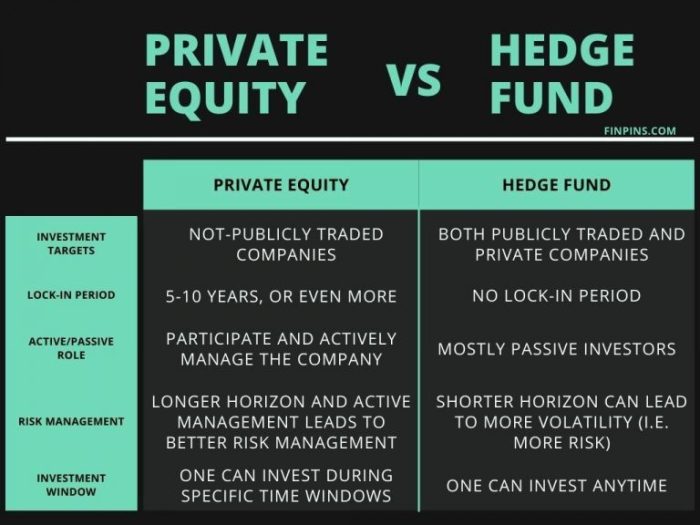
Private equity refers to investments made in privately-held companies or assets that are not traded on public stock exchanges. Unlike hedge funds, private equity firms typically acquire a significant ownership stake in the companies they invest in and play an active role in their management and operations.
Structure of Private Equity Investments
Private equity investments are structured as limited partnerships, with investors contributing capital to the fund managed by a general partner. The general partner makes investment decisions on behalf of the fund, while limited partners provide the capital but have limited control over the investment decisions.
- Private equity funds typically have a fixed term of around 7-10 years, during which the fund manager invests in companies, improves their operations, and seeks to generate returns for investors.
- Once the investment period is over, the fund manager begins to divest the investments and return capital to investors along with any profits earned.
Investment Horizon for Private Equity Funds
Private equity funds have a longer investment horizon compared to hedge funds, with a typical holding period of 5-7 years for each investment. This longer time frame allows private equity firms to implement strategic changes and improvements in the companies they invest in, aiming to increase their value over the long term.
Role of Private Equity in Financial Markets
Private equity plays a crucial role in the financial markets by providing capital to companies that may not have access to traditional sources of funding. Private equity firms often invest in companies with growth potential or in need of restructuring, helping them grow, create jobs, and contribute to the economy. Additionally, private equity investments can offer attractive returns to investors seeking higher yields than those available in public markets.
Hedge Funds vs. Private Equity
Hedge funds and private equity are both alternative investment vehicles that aim to generate high returns for investors. However, they differ significantly in terms of risk profiles, fee structures, liquidity, and regulatory environment.
Risk Profiles
When it comes to risk profiles, hedge funds are known for their more aggressive and riskier investment strategies. Hedge funds often use leverage and derivatives to amplify returns, which can also increase the level of risk involved. On the other hand, private equity funds typically invest in private companies or assets with a longer investment horizon, which may result in lower liquidity but potentially lower risk compared to hedge funds.
Fee Structures
Hedge funds usually charge both a management fee and a performance fee. The management fee is typically a percentage of the assets under management, while the performance fee is a percentage of the profits generated by the fund. Private equity funds, on the other hand, typically charge a management fee based on the committed capital and a carried interest, which is a percentage of the profits above a certain threshold.
Liquidity Differences
Hedge funds are generally more liquid than private equity investments. Investors in hedge funds can typically redeem their investments on a quarterly or even monthly basis, depending on the fund’s redemption terms. In contrast, private equity investments are illiquid and have a longer lock-up period, often ranging from 5 to 10 years before investors can realize their returns.
Regulatory Environment
Both hedge funds and private equity funds are subject to regulatory oversight, but the regulatory environment for each differs. Hedge funds are often subject to securities regulations and may need to register with regulatory authorities. Private equity funds, on the other hand, are subject to regulations governing private investments and may have less stringent reporting requirements compared to hedge funds.
In conclusion, the dynamic interplay between hedge funds and private equity emerges as a crucial component of modern finance, showcasing the diverse opportunities and challenges inherent in these alternative investment avenues.
Frequently Asked Questions
What sets hedge funds apart from other investment vehicles?
Hedge funds are known for their aggressive investment strategies and high-risk tolerance, aiming to generate substantial returns for their investors.
How do private equity investments differ from hedge funds?
Private equity investments involve taking direct ownership stakes in companies, often with a long-term investment horizon, while hedge funds focus on shorter-term trading strategies.
What are the typical fee structures for hedge funds and private equity funds?
Hedge funds usually charge management fees and performance fees based on profits, while private equity funds typically charge management fees and carry interest on profits.
Are hedge funds more liquid than private equity investments?
Generally, hedge funds offer more liquidity as investors can redeem their shares periodically, whereas private equity investments are illiquid and involve longer lock-up periods.
How are hedge funds and private equity funds regulated?
Hedge funds are subject to fewer regulations compared to private equity funds, which face stricter oversight due to their direct ownership of companies and longer-term investments.


