
How Hedge Funds Manage Market Volatility sets the stage for this enthralling narrative, offering readers a glimpse into a story that is rich in detail with casual formal language style and brimming with originality from the outset.
In the realm of finance, the management of market volatility is a crucial aspect that hedge funds navigate with precision and expertise. This article dives into the strategies employed by hedge funds to handle market fluctuations effectively.
Introduction to Hedge Funds
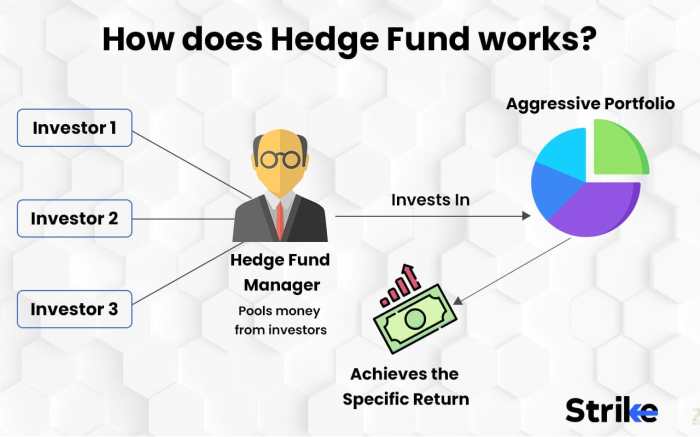
Hedge funds are investment funds that pool capital from accredited or institutional investors to invest in a diverse range of assets. They are known for their flexibility in investment strategies and are typically managed aggressively to generate high returns.
Main Strategies of Hedge Funds
- Long/Short Equity: Hedge funds take both long (buy) and short (sell) positions in stocks to hedge against market risk and generate returns.
- Arbitrage: Hedge funds exploit price differentials in related financial instruments to make a profit.
- Global Macro: Hedge funds invest based on macroeconomic trends and events on a global scale.
- Event-Driven: Hedge funds focus on opportunities arising from corporate events like mergers, acquisitions, or bankruptcies.
Typical Investors in Hedge Funds
Hedge funds typically cater to high-net-worth individuals, pension funds, endowments, and institutional investors. These investors are willing to take on higher risks in exchange for potentially higher returns that hedge funds offer.
Market Volatility and Its Impact
Market volatility refers to the degree of variation in the price of a financial asset within a specific period. It is a crucial aspect of the financial world as it reflects the level of uncertainty and risk in the market.
Significance of Market Volatility
Market volatility plays a significant role in shaping investment decisions. Investors often assess the level of volatility in the market to determine the potential risks and rewards associated with different assets. High volatility can indicate increased uncertainty and potential for large price swings, while low volatility may suggest stability but lower potential returns.
Impact on Investment Decisions
Market volatility directly influences investment decisions as it affects the perceived risk and return of assets. During periods of high volatility, investors may become more cautious and opt for safer investments to mitigate risk. On the other hand, some investors may see volatility as an opportunity to capitalize on price fluctuations and generate higher returns through strategic investments.
Relationship with Hedge Fund Performance
Hedge funds are actively managed investment funds that often aim to generate positive returns regardless of market conditions. The performance of hedge funds is closely tied to market volatility, as fund managers may adjust their strategies based on the level of volatility in the market. In some cases, hedge funds may use strategies such as short-selling or derivatives to hedge against market volatility and protect their portfolios.
Risk Management Strategies
Effective risk management is crucial for hedge funds to navigate through market volatility and protect investors’ capital. Hedge funds employ various strategies to manage risks and optimize returns.
Diversification
Diversification is a key risk management technique used by hedge funds to spread investments across different asset classes, industries, and geographic regions. By diversifying their portfolios, hedge funds can reduce the impact of adverse events on a single investment.
Leverage
Hedge funds often utilize leverage to enhance returns, but it can also increase risks, especially during volatile market conditions. However, when used strategically, leverage can help hedge funds to mitigate risks by amplifying gains and minimizing losses.
Alternative Investment Strategies
In navigating market volatility, hedge funds often employ alternative investment strategies to manage risks and seek returns beyond traditional methods.
Short Selling
Short selling plays a crucial role in hedge fund strategies during volatile markets. This strategy involves borrowing a security and selling it on the market with the expectation of buying it back at a lower price in the future. By betting on the decline of a particular asset, hedge funds can profit from market downturns and hedge against potential losses in their long positions.
Use of Derivatives
Hedge funds utilize derivatives as a risk management tool to hedge against market risks. Derivatives such as options, futures, and swaps allow fund managers to protect their portfolios from adverse price movements. For example, a fund may use options to protect against downside risk or futures contracts to offset potential losses in a specific asset class. By incorporating derivatives into their investment strategies, hedge funds can enhance portfolio diversification and mitigate volatility impact.
In conclusion, the management of market volatility by hedge funds showcases a blend of calculated risk-taking and strategic decision-making. By understanding these dynamics, investors can gain valuable insights into navigating uncertain financial landscapes with confidence.
FAQ Guide
How do hedge funds manage market volatility?
Hedge funds manage market volatility by employing various strategies such as diversification, leverage, and alternative investment techniques to mitigate risks and capitalize on opportunities.
What is the role of short selling in hedge fund strategies during volatile markets?
Short selling allows hedge funds to profit from declining asset prices during volatile markets, providing a way to hedge against potential losses.


