
Best Hedge Fund Strategies for Beginners sets the stage for this enthralling narrative, offering readers a glimpse into a story that is rich in detail and brimming with originality from the outset.
As we delve into the world of hedge funds, we discover the key strategies that can pave the way for novice investors to navigate the complex terrain of investments.
Introduction to Hedge Funds
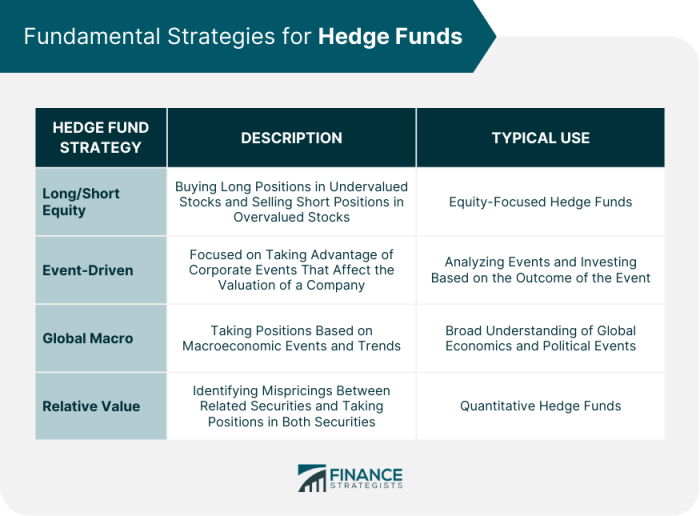
Hedge funds are investment funds that pool capital from accredited individuals or institutional investors and use various strategies to generate high returns. Unlike traditional investment funds, hedge funds typically have more flexibility in their investment strategies and can invest in a wide range of assets, including stocks, bonds, derivatives, and real estate.
The primary purpose of hedge funds is to maximize returns for their investors by using a combination of long and short positions, leverage, and other sophisticated techniques. They aim to outperform the broader market and provide investors with above-average returns.
Benefits of Investing in Hedge Funds
- Hedge funds have the potential to generate higher returns compared to traditional investment funds.
- Investors in hedge funds benefit from the expertise of skilled fund managers who employ advanced trading strategies.
- Hedge funds can provide diversification benefits to an investment portfolio by investing in non-traditional assets.
Risks Associated with Investing in Hedge Funds
- Hedge funds typically charge higher fees compared to traditional investment funds, which can eat into returns.
- Hedge funds may use leverage and other risky strategies that can result in significant losses for investors.
- Hedge funds are less regulated than traditional investment funds, which can expose investors to higher levels of risk and potential fraud.
Best Hedge Fund Strategies for Beginners
When it comes to hedge fund strategies, beginners need to carefully consider their options to maximize returns while managing risks effectively. Here, we will explore some key hedge fund strategies that are suitable for novice investors, comparing and contrasting them in terms of their risk and return potential.
Long/Short Equity Strategy
The long/short equity strategy involves taking long positions in undervalued stocks while shorting overvalued stocks. This strategy aims to profit from both rising and falling markets by betting on individual companies.
Global Macro Strategy
The global macro strategy focuses on making broad bets on various asset classes based on macroeconomic trends. This approach allows investors to capitalize on global economic shifts and geopolitical events.
Event-Driven Strategy
The event-driven strategy involves investing in companies undergoing significant corporate events such as mergers, acquisitions, or restructurings. By analyzing these events, investors seek to profit from price inefficiencies that arise.
Market-Neutral Strategy
The market-neutral strategy aims to profit from relative price movements while minimizing exposure to overall market direction. By pairing long and short positions, investors seek to hedge against market risk and focus on stock-specific factors.
Long-Short Equity Strategy
The long-short equity strategy is a popular investment approach used by hedge funds to take both long and short positions in stocks with the aim of generating returns regardless of market direction. The primary objective of this strategy is to capitalize on both rising and falling stock prices by buying undervalued stocks (long positions) and selling overvalued stocks (short positions).
Implementing a Long-Short Equity Strategy
To implement a long-short equity strategy, beginners can start by conducting thorough research and analysis of individual stocks to identify potential long and short opportunities. It is essential to diversify the portfolio by selecting a mix of long and short positions to reduce risk exposure. Additionally, risk management is crucial to protect against potential losses in volatile market conditions.
- Utilize fundamental analysis to identify undervalued and overvalued stocks.
- Implement strict risk management practices to control downside risk.
- Regularly monitor and adjust positions based on market conditions and new information.
Successful Long-Short Equity Hedge Funds
Some examples of successful long-short equity hedge funds include:
Soros Fund Management: Known for its successful long-short equity strategy and macroeconomic analysis.
Bridgewater Associates: Utilizes a diversified approach to long-short equity investing with a focus on risk management.
Coatue Management: Specializes in technology and consumer-focused long-short equity investments.
Global Macro Strategy
Global macro strategy is an investment approach that focuses on making bets on macroeconomic trends across various markets worldwide. Instead of analyzing individual companies or assets, global macro investors study factors like interest rates, economic policies, political events, and other macro indicators to make investment decisions.
Benefits and Challenges of Adopting a Global Macro Strategy for Beginners
- Benefits:
- Opportunity to profit from large-scale market movements based on global trends.
- Diversification across different asset classes and geographies to reduce risk.
- Potential for high returns if macroeconomic forecasts are accurate.
- Challenges:
- Requires a deep understanding of global economics and political events.
- Highly dependent on accurate macroeconomic forecasting, which can be challenging for beginners.
- Risk of significant losses if macroeconomic trends do not materialize as expected.
Key Considerations when Implementing a Global Macro Strategy in a Hedge Fund
- Understand the global economic landscape and how different factors influence markets.
- Develop a robust risk management strategy to mitigate potential losses from unexpected events.
- Stay informed about geopolitical events, central bank policies, and economic data releases that could impact investment decisions.
- Regularly review and adjust the portfolio based on changing macroeconomic conditions to optimize returns.
In conclusion, mastering the best hedge fund strategies is a crucial step towards financial success for beginners, providing a solid foundation for their investment journey.
Frequently Asked Questions
What are some common risks associated with hedge fund investments?
Some common risks include high fees, lack of liquidity, and potential market volatility.
How can beginners identify the right hedge fund strategy for their investment goals?
Beginners should assess their risk tolerance, investment objectives, and research different strategies to find the best fit.
Are hedge funds suitable for all types of investors?
No, hedge funds are typically more suited for accredited or high-net-worth investors due to their complex nature and higher risk profile.


