
Embark on a journey into the world of hedge fund returns and risk assessment, where calculations, metrics, and strategies intertwine to shape the landscape of investment.
Delve deeper into the nuances of evaluating hedge fund returns and managing risks to uncover the intricate workings of this complex financial realm.
Hedge Fund Returns
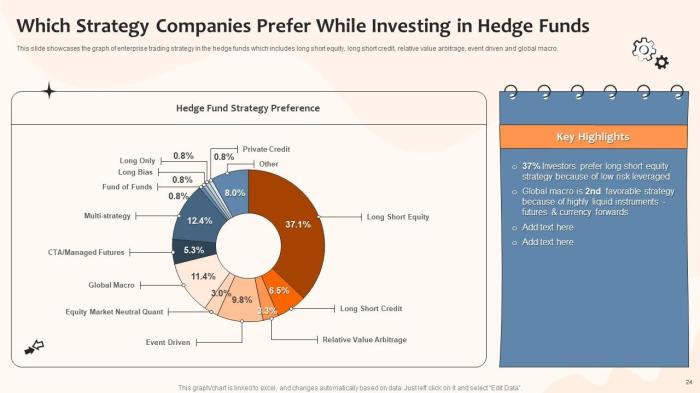
When it comes to hedge fund returns, it is essential to understand how these returns are calculated and evaluated. Different metrics are used to assess the performance of hedge funds, and benchmarking plays a crucial role in this process. Let’s dive deeper into the intricacies of hedge fund returns.
Calculating Hedge Fund Returns
Hedge fund returns are typically calculated by taking into account the change in the net asset value (NAV) of the fund over a specific period. This can be done using the formula:
Return = (Ending NAV – Beginning NAV + Cash Flow) / Beginning NAV
Metrics for Evaluating Hedge Fund Returns
- Sharpe Ratio: Measures the risk-adjusted return of a hedge fund.
- Sortino Ratio: Focuses on downside risk and provides a more accurate picture of a fund’s performance.
- Jensen’s Alpha: Assesses a fund’s excess return compared to its expected return based on its beta.
Significance of Benchmarking in Hedge Fund Returns
Benchmarking involves comparing a hedge fund’s performance against a designated benchmark index, such as the S&P 500. This helps investors understand how well the fund is performing relative to the market and provides valuable insights into its risk-adjusted returns.
Absolute vs. Relative Returns in Hedge Funds
Absolute returns focus on the fund’s actual performance in generating profits, while relative returns assess how the fund performs compared to a benchmark or peer group. Both metrics are crucial in evaluating a hedge fund’s success and can offer different perspectives on its performance.
Risk Assessment in Hedge Funds
When it comes to hedge funds, risk assessment plays a crucial role in determining investment strategies and potential returns. Understanding the various types of risks associated with hedge funds is essential for investors looking to navigate this complex financial landscape.
Types of Risks in Hedge Funds
- Market Risk: This type of risk stems from changes in market conditions, such as fluctuations in interest rates, currency values, or stock prices.
- Liquidity Risk: Refers to the potential difficulty in selling assets quickly without causing a significant impact on their price.
- Operational Risk: Arises from internal processes, systems, or human error that could lead to financial losses.
- Counterparty Risk: The risk of financial loss due to a counterparty failing to fulfill their obligations.
Risk Management in Hedge Funds
Risk management strategies in hedge funds differ from traditional investment funds due to the higher level of flexibility and complexity involved. Hedge fund managers often employ a combination of hedging techniques, leverage, and derivatives to manage risks and maximize returns.
Volatility in Risk Assessment
Volatility is a key factor in risk assessment for hedge funds, as it measures the degree of variation in asset prices over time. Higher volatility typically indicates higher risk, but it can also present opportunities for profit if managed effectively.
Tools and Techniques for Measuring Risk
- Value at Risk (VaR): A statistical tool used to estimate the maximum potential loss in a portfolio over a specific time horizon at a given confidence level.
- Stress Testing: Involves analyzing how a portfolio would perform under various adverse scenarios to assess its resilience to market shocks.
- Scenario Analysis: Examines the impact of specific events or changes in market conditions on a portfolio’s value and risk exposure.
Hedge Fund Strategies
When it comes to hedge fund strategies, there are various approaches that fund managers can take to achieve their investment goals. These strategies play a crucial role in determining the returns and risks associated with a hedge fund.
Common Hedge Fund Strategies and Their Impact
- Long/Short Equity: This strategy involves taking long positions in stocks expected to increase in value and short positions in stocks expected to decrease. It aims to profit from both rising and falling markets, potentially reducing overall portfolio risk.
- Global Macro: Global macro funds take positions in various asset classes based on macroeconomic trends and events. These funds can benefit from economic shifts and geopolitical developments.
- Event-Driven: Event-driven strategies focus on specific corporate events such as mergers, acquisitions, bankruptcies, or restructurings. Fund managers aim to capitalize on price discrepancies resulting from these events.
Relationship Between Strategy Selection and Risk Management
Choosing the right hedge fund strategy is crucial for effective risk management. Each strategy comes with its own set of risks and potential rewards. Fund managers must align their strategy selection with their risk tolerance and overall investment objectives to optimize returns while managing risk effectively.
Macroeconomic Factors and Strategy Performance
Macroeconomic factors such as interest rates, inflation, and geopolitical events can significantly impact hedge fund strategy performance. For example, a global macro fund may adjust its positions based on changes in interest rates or currency valuations to capitalize on market opportunities.
Real-World Examples of Successful Strategies
- Quantitative Trading: Renaissance Technologies’ Medallion Fund is known for its quantitative trading strategy that utilizes complex algorithms to identify profitable trading opportunities.
- Distressed Debt: Baupost Group, led by Seth Klarman, has achieved success through its distressed debt strategy, investing in undervalued or distressed securities for long-term growth.
- Merger Arbitrage: The Merger Fund managed by Westchester Capital Management focuses on merger arbitrage, profiting from price differentials between the current stock price and the expected merger price.
Hedge Fund Performance Evaluation
When evaluating the performance of a hedge fund, several key factors come into play to provide a comprehensive analysis. These factors help investors assess the fund’s success and potential for future returns.
Key Factors in Evaluating Hedge Fund Performance
- Annual Returns: Analyzing the fund’s annual returns is crucial to understanding its performance over time and comparing it to relevant benchmarks.
- Volatility: Assessing the fund’s volatility can indicate the level of risk involved and how it may impact returns.
- Sharpe Ratio: The Sharpe ratio measures the risk-adjusted return of the fund, providing insight into how well it has performed relative to the risk taken.
- Maximum Drawdown: Understanding the maximum drawdown helps investors gauge the fund’s downside risk and potential losses.
Importance of Risk-Adjusted Returns
Risk-adjusted returns are essential in assessing hedge fund performance as they account for the level of risk taken to achieve a certain return. This metric helps investors understand if the fund is generating returns efficiently given the amount of risk involved.
Peer Group Analysis in Evaluating Hedge Fund Performance
- Peer group analysis involves comparing a hedge fund’s performance to other funds with similar strategies or objectives. This allows investors to benchmark the fund’s performance within its peer group and assess its relative success.
- By analyzing peer group performance, investors can gain insights into how a fund stacks up against its competitors and identify areas of strength or weakness.
Comparison of Performance Measurement Techniques
- Traditional Metrics: Common performance measurement techniques include absolute returns, relative returns, and risk-adjusted returns like the Sharpe ratio and Sortino ratio.
- Qualitative Analysis: Qualitative factors such as fund manager expertise, investment strategy, and risk management practices are also important considerations in evaluating hedge fund performance.
- Benchmarking: Benchmarking against relevant indices or peer groups helps investors assess how well a fund is performing compared to the broader market or similar funds.
In conclusion, the intricate dance between hedge fund returns and risk assessment offers a captivating glimpse into the dynamic world of finance, where calculated decisions pave the way for success.
Questions and Answers
How are hedge fund returns calculated?
Hedge fund returns are typically calculated using a combination of the fund’s net asset value (NAV) and performance fees.
What is the significance of benchmarking in assessing hedge fund returns?
Benchmarking helps investors understand how a hedge fund’s performance compares to a designated standard or index, providing valuable insights into its relative success.
How do risk management strategies differ in hedge funds compared to traditional investment funds?
Risk management in hedge funds often involves more complex strategies due to the diverse range of assets and derivatives they utilize compared to traditional funds.
What role does volatility play in risk assessment for hedge funds?
Volatility is a key factor in assessing risk for hedge funds as it indicates the degree of fluctuation in returns, helping investors gauge potential losses.
What are some tools and techniques used for measuring risk in hedge funds?
Tools like Value at Risk (VaR) and stress testing techniques are commonly used to measure and manage risk in hedge funds.


